- 1/2 14oz Block Silken Tofu
- 1/2 Teaspoon Salt
- 1/2 Teaspoon Onion Powder
- 1/2 Teaspoon Champagne Vinegar or White Vinegar
- 1 Tablespoon Lemon Juice
- 1/2 Tablespoon Olive Oil
- 1 Tablespoon Corn Starch
- 2 Teaspoons Sugar
Saturday, May 3, 2008
Vegan Mayo
Courtesy of My Vegan Cookbook! Having managed to drop and break a very large & nearly new jar of vegannaise several days back (shifting stuff round in the fridge to get to other stuff) I will just have to live without 'til we get back to whole foods in several weeks - or make my own. Might be worth a try.


Black Eyed Pea, Rice, & Mustard Green Stew
All credit here to the blog More to Love Vegan, which really IS more vegan to love, not to mention an absolutely delightful writing style (and don't I just sound veddy veddy!) I can't wait to try this. I'll have to sub out the 'chicken' stock since I have no 'chickenish' flavoring and only our own wonderful veg stock - maybe I can put in some sage, etc.
1 tablespoon sesame oil
2 medium onions, finely diced
3 bay leaves
2 celery ribs, diced
3 garlic clove, chopped
1 teaspoon dried thyme
1/2 teaspoon hot red pepper flakes
1 teaspoon paprika
1 teaspoon ground cumin
3 tablespoons celery leaves, chopped
1 tablespoon tomato paste
2 cups black eyed peas (from 1 cup that has been soaked for at least 8 hours)
1.5 litres massel "chicken" stock
sea salt to taste
fresh ground pepper to taste
1 bunch mustard greens
1 cup cooked brown rice
Directions
1. Heat the oil in a wide soup pot over medium heat until it becomes fragrant
2. Add the onions, bay leaves, celery, garlic, thyme, chile flakes, smoked paprika, cumin and celery leaves.
3. Cook stirring occasionally, until the onions have browned, about 20 minutes.
4. Stir in the tomato paste, then add the beans (drain them first if you used soaked dried) and the 1.5 litres of stock
5. Simmer, covered, until the beans are tender. Season with salt and pepper
6. Cut the mustard greens off at their stems and wash them. Add directly to the beans and let simmer for approximately 3 minutes.
7. Make your final seasoning adjustments.
8. Add a few spoonfuls of rice to each bowl and top with the stew. Serve with tabasco or hot sauce of choice.
Saturday, April 26, 2008
Home made soy milk!
I got my Soyabella soy milk maker! I used it the other night for the first time, making 2 batches. It was really super easy. I used the okara to make felafel and pita bread (both recipes here on the blog). Did you know that okara added to bread dough lends it loft and (of course) LOTS of good for you things? me neither. but I've found a number of recipes to try for using up okara, including pasta. check my blog for the results of my searching.
I'm definitely going to make some tofu as soon as I get some cheesecloth, too.i
We still have some commercially produced soy milk left, so I can't really report on the taste yet. But Mike says it's beanier (this does not bother me a bit).
Updates: I've been adding a touch more sugar, and found a way to double-filter the soy milk (using a paper coffee filter after I use the regular (gold) coffee filter) as a way to avoid the very fine and sludgy okara that settles, and that may contribute to the 'beany' or bitter taste. My cereal this morning with milk done this way was fresh and really tasty, much better than cow's milk ever tasted to me. Note: cut sugar a bit, to 1 1/2 T.
Also!! I just made tofu for the first time! I know, enough with the exclamation marks. tough, deal with it. Was it a hassle? Yes, because this first time round I think I used nearly every pot and pan in the kitchen. Even with that, the process was not all that bad - a series of small, easy steps. and it's beautiful (and it's what's for dinner, broiled after marinating simply, with collards and maybe some spiced-up roasted potatoes. More later on the actual taste (details, details).
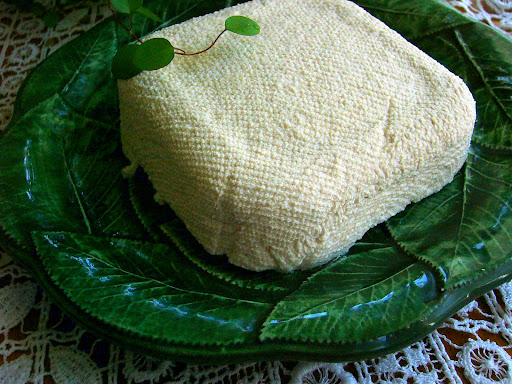
HOME MADE TOFU
This is a mix of recipes, suited to what I have (I have no nigari, for example - I mean to get some). The basic recipes are from Bryanna Clark Grogan and Just Hungry.
1. 2 or 3 quarts of freshly made soy milk
2. muslin or cheesecloth
3. strainer
4. large pot
Follow the instructions for making soy milk, but instead of putting the strained milk someplace where it can cool down, put into a large pot on the stove on the lowest heat. It should not boil, but just stay hot. If you are using previously made soy milk, heat it up so that it's hot but not boiling. Use a thermometer if you want to be precise - it should be around 75°C / 165°F.
Now add your coagulent. This can be a variety of things. Brianna uses epsom salts; some use nigari, and you can also use lemon juice or vinegar.
For NIGARI
Make your nigari mixture by dissolving 4 teaspoons of powdered nigari in a cup of lukewarm water until the powder is dissolved. (This amount is for the soy milk created from 500g / about 1 lb of dry soy beans, as described in Part 1.) Stirring the warm soy milk, add the nigari liquid in stages, stirring then waiting a bit between additions. As soon as the curd starts to separate from the liquid, stop adding.
For EPSOM SALTS
"For this amount of milk (3 qts), I use two heaping tablespoons of Epsom salts, dissolved in 1/2 cup boiling water. The reason you don't want to add all the nigari at once is because it has a slightly bitter taste, so you want to add a little as possible while still achieving a good degree of coagulation. Most of the time though, the entire amount can be added.
Turn off the heat, and put a tight fitting lid on the pot. Leave for at least 15 minutes, then take a look, stirring very gently to see the state of the curds. They should be fairly big and totally separated from the yellowish liquid. If the white particles are still very small and floating all around in the liquid, add the rest of the nigari liquid if you have some left, or make up an additional teaspoonful's worth of powder and water. Stir in, and put the lid back on for an additional 10-15 minutes." (Bryanna)
for LEMON JUICE or VINEGAR
"*In general, the amount of coagulant is 0.25 to 0.5% of cooked soymilk by weight. Ellen's note: If you don't have calcium coagulant, try to get it, but if you can't, to prepare your solidifier, combine 1 cup warm water with one of the following: 2 tsp. Epsom salts, 2 tsp. nigari, 1/4 cup vinegar or 1/4 cup lemon juice. They take about twice as much volume and need about twice as long as the calcium sulfate.
Cut in 3/4 of the coagulant. Cut gently but persistently in one direction, do not whip or beat. As soon as the curd begins to firm, immediately STOP stirring and cover. Allow the curd to set without disturbing for 10 minutes. If there are any milky patches, shake up the coagulant again and stir in a little more coagulant this way: sprinkle the rest of the solidifier in and poke the top gently and let it sit again for a few minutes. Make sure to stir coagulating tofu gently so as not to break up the curds. It ends up soft white clumps in a yellow whey. If the coagulant is poured in too fast or beaten, the curd breaks apart and won't clump well. Too slowly and it starts coagulating early, creating hard blocks." from Ellen's Kitchen.
Cover the pan and let it sit for around 15-20 minutes. Next, take a sieve and gently ladle out the clear liquid (or as much as possible without disturbing the curds that have now sunk to the bottom of the pan).
Ladle the curds into a press lined with cheesecloth. I use a cheap grocery store storage box, the kind that comes in packs of 3 or 4, and have drilled holes in it for drainage, and cut the lid so it will fit inside the box.
Wrap the cheesecloth over the top. Put the lid on the top of that, and set a 15 oz can atop all this. Leave it for an hour or so, then (if you want) add more weight to get the tofu firmer.
I'm definitely going to make some tofu as soon as I get some cheesecloth, too.i
We still have some commercially produced soy milk left, so I can't really report on the taste yet. But Mike says it's beanier (this does not bother me a bit).
Updates: I've been adding a touch more sugar, and found a way to double-filter the soy milk (using a paper coffee filter after I use the regular (gold) coffee filter) as a way to avoid the very fine and sludgy okara that settles, and that may contribute to the 'beany' or bitter taste. My cereal this morning with milk done this way was fresh and really tasty, much better than cow's milk ever tasted to me. Note: cut sugar a bit, to 1 1/2 T.
Also!! I just made tofu for the first time! I know, enough with the exclamation marks. tough, deal with it. Was it a hassle? Yes, because this first time round I think I used nearly every pot and pan in the kitchen. Even with that, the process was not all that bad - a series of small, easy steps. and it's beautiful (and it's what's for dinner, broiled after marinating simply, with collards and maybe some spiced-up roasted potatoes. More later on the actual taste (details, details).
HOME MADE TOFU
This is a mix of recipes, suited to what I have (I have no nigari, for example - I mean to get some). The basic recipes are from Bryanna Clark Grogan and Just Hungry.
1. 2 or 3 quarts of freshly made soy milk
2. muslin or cheesecloth
3. strainer
4. large pot
Follow the instructions for making soy milk, but instead of putting the strained milk someplace where it can cool down, put into a large pot on the stove on the lowest heat. It should not boil, but just stay hot. If you are using previously made soy milk, heat it up so that it's hot but not boiling. Use a thermometer if you want to be precise - it should be around 75°C / 165°F.
Now add your coagulent. This can be a variety of things. Brianna uses epsom salts; some use nigari, and you can also use lemon juice or vinegar.
For NIGARI
Make your nigari mixture by dissolving 4 teaspoons of powdered nigari in a cup of lukewarm water until the powder is dissolved. (This amount is for the soy milk created from 500g / about 1 lb of dry soy beans, as described in Part 1.) Stirring the warm soy milk, add the nigari liquid in stages, stirring then waiting a bit between additions. As soon as the curd starts to separate from the liquid, stop adding.
For EPSOM SALTS
"For this amount of milk (3 qts), I use two heaping tablespoons of Epsom salts, dissolved in 1/2 cup boiling water. The reason you don't want to add all the nigari at once is because it has a slightly bitter taste, so you want to add a little as possible while still achieving a good degree of coagulation. Most of the time though, the entire amount can be added.
Turn off the heat, and put a tight fitting lid on the pot. Leave for at least 15 minutes, then take a look, stirring very gently to see the state of the curds. They should be fairly big and totally separated from the yellowish liquid. If the white particles are still very small and floating all around in the liquid, add the rest of the nigari liquid if you have some left, or make up an additional teaspoonful's worth of powder and water. Stir in, and put the lid back on for an additional 10-15 minutes." (Bryanna)
for LEMON JUICE or VINEGAR
"*In general, the amount of coagulant is 0.25 to 0.5% of cooked soymilk by weight. Ellen's note: If you don't have calcium coagulant, try to get it, but if you can't, to prepare your solidifier, combine 1 cup warm water with one of the following: 2 tsp. Epsom salts, 2 tsp. nigari, 1/4 cup vinegar or 1/4 cup lemon juice. They take about twice as much volume and need about twice as long as the calcium sulfate.
Cut in 3/4 of the coagulant. Cut gently but persistently in one direction, do not whip or beat. As soon as the curd begins to firm, immediately STOP stirring and cover. Allow the curd to set without disturbing for 10 minutes. If there are any milky patches, shake up the coagulant again and stir in a little more coagulant this way: sprinkle the rest of the solidifier in and poke the top gently and let it sit again for a few minutes. Make sure to stir coagulating tofu gently so as not to break up the curds. It ends up soft white clumps in a yellow whey. If the coagulant is poured in too fast or beaten, the curd breaks apart and won't clump well. Too slowly and it starts coagulating early, creating hard blocks." from Ellen's Kitchen.
Cover the pan and let it sit for around 15-20 minutes. Next, take a sieve and gently ladle out the clear liquid (or as much as possible without disturbing the curds that have now sunk to the bottom of the pan).
Ladle the curds into a press lined with cheesecloth. I use a cheap grocery store storage box, the kind that comes in packs of 3 or 4, and have drilled holes in it for drainage, and cut the lid so it will fit inside the box.
Wrap the cheesecloth over the top. Put the lid on the top of that, and set a 15 oz can atop all this. Leave it for an hour or so, then (if you want) add more weight to get the tofu firmer.
Roasted tamari chickpeas
1 can or 2 cups cooked chickpeas
1 tbsp tamari
1-2 tsp lemon or lime juice
taco seasoning or 2 tbsp menudo mix (taco seasoning recipe also available through the link, below)
whisk tamari, juice & spices
add rinsed chickpeas and toss until coated
place on tray, spray with oil
bake 400F 20-25minutes
This recipe is amended from the terrific Happy Herbivore blog, where the chickpeas are incorporated into blue corn tacos! Thanks for correcting my mis-linking, too - very much appreciated!
Friday, April 25, 2008
Okara Pita Bread
The pita bread made from this recipe was much lighter than previous recipes, and I've tried 3 or 4. It's a great way to use your akara, and I think next time, I'll up the whole wheat flour, and perhaps try adding either sauteed onion or sesame seeds to the top after I roll the pitas out, and before baking.
2 cups warm water (no more than a warmish body temp or the yeast will die)
1 tablespoon yeast
2 tablespoons honey (or vegan sub - I used agave nectar)
1/2 tablespoon salt (I cut this in 1/2 from the original recipe)
1/2 cup warm wet okara (or substitute mashed soft tofu)
1 cup whole wheat flour
4 to 5 cups unbleached all purpose flour
from Okara mountain
2 cups warm water (no more than a warmish body temp or the yeast will die)
1 tablespoon yeast
2 tablespoons honey (or vegan sub - I used agave nectar)
1/2 tablespoon salt (I cut this in 1/2 from the original recipe)
1/2 cup warm wet okara (or substitute mashed soft tofu)
1 cup whole wheat flour
4 to 5 cups unbleached all purpose flour
- In a large mixing bowl mix the water, yeast and honey or substitute well.
- Let sit for 5 minutes to dissolve the yeast.
- Mix in salt and okara.
- Add one cup whole wheat flour and two cups of the unbleached all purpose flour. Beat well to develop the gluten. Continue to add the rest of the white flour until you get a stiff dough. Knead the dough for at least 10 minutes. Cover the bowl with a clean kitchen towel and place in a warm spot to rise for approximately 1 hour.
- After the hour, punch the dough down, and knead a few times. Preheat the oven to 450 degrees. Divide the dough into 12-15 portions (the original recipe said 10-12, but with the okara it makes lots more!) Roll the portions into balls, cover and let rest for 10 minutes.
- After the 10 minutes, take a ball of dough, and flatten it to 1/4" with a rolling pin, shaping it into a round. Place on a greased cookie sheet. Repeat for the remainder of the dough, placing two to a cookie sheet (3 if smaller). Bake for 5 - 7 minutes until browned. Make sure to keep your eye on these because I've found that with successive batches, the oven temp goes up!
- Move to a wire rack to cool while you flatten and bake the rest of the dough. Makes approximately 12-15 pitas.
from Okara mountain
Tangy Yogurt Sauce
Tangy Yogurt Sauce
3/4 cup tahini
1 tablespoon natural creamy peanut butter (optional)
1-1/2 cup plain yogurt
1 large clove garlic, finely minced
1/4 cup green onions, finely minced
1/4 cup fresh lemon juice
1/4 cup fresh parsley, finely minced
1 tablespoon fresh basil, finely minced (optional)
1/4 teaspoon salt
1/2 teaspoon cumin
1/8 teaspoon paprika
dash cayenne
In a medium sized mixing bowl combine sauce ingredients and beat well. Refrigerate any sauce that is left over and use it for dip for raw veggies, or as a salad dressing.
Okara Felafel
I just made this tonight, and it makes a TON of felafel (I mean really, it made about 30 1" balls)! next time I'll cut it in half. I added some chopped flat leaf parsley, which worked very well. This felafel was my own first attempt at homemade - it is light, tasty, and very very different from the prepared boxes you just add water to. We decided we like that granular (and firmer) box mix, or at least, that aspect of it. I'll be fiddling with this recipe to get it where we want it - it's definitely a keeper! Maybe if I add cornmeal (or mix in chickpea flour) I'll have firmer texture - another option might be to drain and press the okara.
2 (15 ounce) can chickpeas (drained, rinsed, and mashed)
1 cup wet okara
2 large cloves garlic, minced
1/2 cup celery, minced
1/2 cup green onions, (white portion only) minced
1/2 teaspoon tumeric
1/2 teaspoon cumin
1/4 teaspoon paprika
cayenne (dash or to taste)
1-1/2 teaspoons salt
3-1/2 tablespoons white unbleached flour (you will need extra for coating)
3 tablespoons tahini
2 egg replacements, beaten
In a large mixing bowl, combine above ingredients well. Chill mixture for at least one hour or more. With your hands dusted with flour, scoop out mixture to make 1" balls. Coat the balls with flour. Heat a 2"- 3" pool of oil in a heavy skillet or heavy saucepan to 365 degrees. Deep fry the Felafel (three at a time, depending on size of skillet or pan...don’t overcrowd) until golden brown. Hold in a warm oven until done frying all the Felafel. Serve warm with Tangy Yogurt Sauce.
recipe from Okara Mountain, which I recommend highly - this looks fantastic!
Okara hummus
1 cup okara
1 lb canned chick-pea (about 1 1/2 cups)
1/4 fresh lemon juice
6 garlic cloves
1/4 cup extra virgin olive oil (more if you like a thinner hummus)
2 tablespoon tahini
salt and pepper
Saute the garlic cloves in olive oil until golden brown. (This eliminates the garlic "kick" that a lot of people find offensive, and the flavor of roasted garlic adds a warm taste to the hummus.).
add the chickpeas to a food processor or blender and blend until smooth.
Add all of the other ingredients. Adjust the seasonings to taste.
Serve with raw vegetable crudites, crackers, or toasted pita points.
from Recipezaar, amended
drying okara & using it in breads
spread okara out on a baking sheet, then bake at 300F until completely dry, stirring every 10-15 minutes. After it's done, whir in food processor to get rid of lumps, then bag to store in refrigerator or freezer.
Add 1/4 - 1 cup of the dried okara to bread recipes (without altering the recipe otherwise) for a light texture.
To add a cup of cooked (undried) okara to bread, decrease the liquid in the bread recipe by 2 ounces (to 10 ounces) and increase flour by 1/4 cup (to 2-3/4 cup).
Add 1/4 - 1 cup of the dried okara to bread recipes (without altering the recipe otherwise) for a light texture.
To add a cup of cooked (undried) okara to bread, decrease the liquid in the bread recipe by 2 ounces (to 10 ounces) and increase flour by 1/4 cup (to 2-3/4 cup).
Okara tropical granola
* 5 cups okara (if homemade, 'fluff' it first, then measure)
* 1/4 cup sesame oil
* 1 1/2 cups quick cooking oats
* 1 cup brown rice syrup
* 1 1/3 cup shredded coconut
* 1 cup sliced almonds
* 1 fluid oz. coconut essence (a small bottle)
* 1/2 - 1 teaspoon sea salt
Directions
1. Preheat oven to 325F.
2. In a large mixing bowl, combine all ingredients and mix thoroughly.
3. Spread mix no more than 1/2 inch thick over a large cookie sheet that has been sprayed with non-stick cooking spray.
4. Bake for about 1 hour, stirring occasionally until desired color/crispness is attained.
5. Cool and store in an airtight container (in refrigerator for longer life).
from grouprecipes
Subscribe to:
Posts (Atom)


